How to Sew Fabric Coasters: A Set of Four for Beginners
Sew four padded cotton coasters from 5 in squares: stack three layers, stitch leaving a turning gap, clip the corners, turn and topstitch.
Tutorial at a glance
Materials
- Eight 5 in (12.5 cm) squares of quilting cotton
- Four 5 in (12.5 cm) squares of cotton batting or craft felt
- All-purpose sewing thread
- Pins or clips
- Fabric scissors
- Ruler and chalk or pencil
- Hand needle or sewing machine
- Iron
- Blunt point such as a chopstick
- Twine for bundling
Learning how to sew fabric coasters teaches the sequence behind most small sewn items: stitch two pieces right sides together, leave a turning gap, turn the piece right side out, and topstitch it closed. Each coaster is a padded square, and four of them make a set.
The seams are short and straight, so the project works equally well on a sewing machine or by hand with backstitch. All measurements below use a 1/4 in (6 mm) seam allowance.
What You Need
- Quilting cotton: eight squares, each 5 in (12.5 cm)
- Cotton batting or craft felt: four squares, each 5 in (12.5 cm)
- All-purpose sewing thread
- Pins or clips, fabric scissors, a ruler and chalk or a pencil
- A hand needle or a sewing machine
- An iron, and a blunt point such as a chopstick for the corners
Pre-wash and press the cotton before cutting, following its care label, so any shrinkage happens before the coasters are sewn. One fat quarter, a pre-cut piece of about 18 x 22 in (46 x 56 cm), yields up to twelve 5 in squares, which is more than enough for the tops or the backs of a set. The tools are described in the guide to a basic kit for paper and fabric projects.
| Set size | Cotton squares | Batting or felt squares | Finished coaster |
|---|---|---|---|
| One coaster | 2 | 1 | About 4 1/2 in (11.5 cm) square |
| Set of four | 8 | 4 | About 4 1/2 in (11.5 cm) square |
| Set of six | 12 | 6 | About 4 1/2 in (11.5 cm) square |
The Three Layers
A finished coaster is a sandwich of three squares: the backing fabric at the bottom, the batting in the middle, and the top fabric above it. The batting gives the coaster body so it lies flat and feels substantial. Craft felt can replace it and gives a slightly thinner, firmer result.
Cut accurately. If the three squares differ in size, the edges will not line up and the seam will miss one layer. Mark each square with a ruler and cut on the line rather than cutting around a rough template.
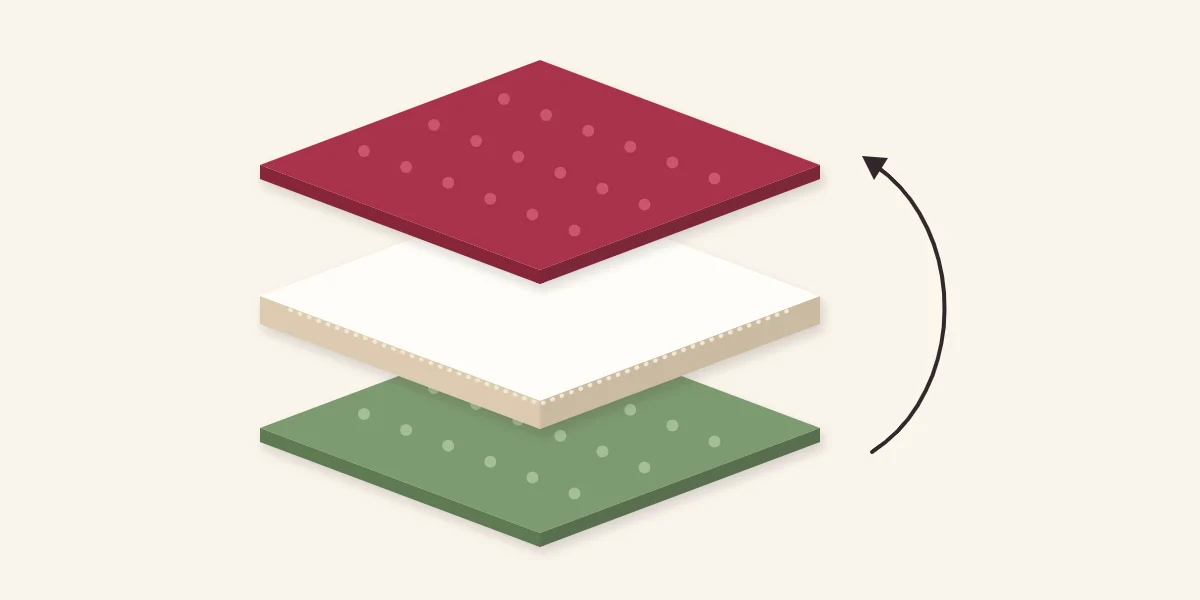
Stack the Layers for Sewing
The sewing order is different from the finished order, because the coaster is sewn inside out and then turned. Stack the pieces like this:
- Batting square on the table.
- Top fabric on the batting, right side up.
- Backing fabric on top, right side down.
The two cotton squares now face each other, right sides together, with the batting underneath. When the piece is turned through the gap, the batting ends up between them. Pin or clip all four sides, and mark a turning gap about 2 in (5 cm) long in the middle of one side with two pins set crosswise or two chalk ticks.
Sewing, Clipping and Topstitching
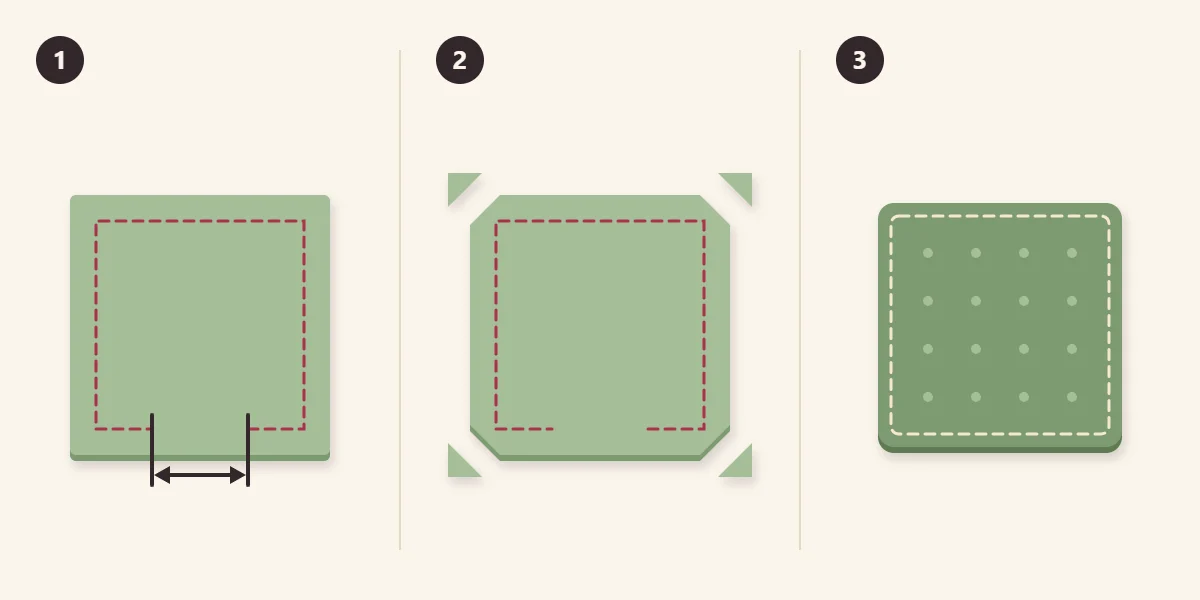
- Stitch around the square, leaving the gap. Begin at one gap mark and sew around all four sides with a 1/4 in (6 mm) seam allowance, stopping at the other gap mark. At each corner, stop with the needle down in the fabric, turn the work a quarter turn and continue. Secure the stitching at the start and end with a few backward stitches, because turning puts strain on both sides of the gap.
- Clip the corners. Cut diagonally across each corner, close to the stitching without cutting through it. This removes bulk so the corners turn into points instead of rounded lumps. If the batting is thick, trim it close to the seam line all the way around as well.
- Turn and topstitch. Reach through the gap between the two cotton layers and pull the coaster right side out. Push each corner out gently with the blunt point. Fold the gap’s raw edges inward by the seam allowance so they line up with the sewn edge, and press the coaster flat, setting the iron according to the fabric’s care label. Then topstitch all the way around, about 1/8 in (3 mm) from the edge. This line closes the gap and keeps the layers from shifting.
Sewing by Hand
Use backstitch for the seam. It forms a continuous line with no spaces between stitches, so it holds up to turning far better than running stitch. Draw the seam line 1/4 in (6 mm) from the edge with a ruler and pencil on the wrong side of the backing, and keep stitches about 1/8 in (3 mm) long. Felt is easier than lofty batting to hand sew through.
For the last step, either topstitch with small, even running stitches in a matching or contrasting thread, or close the gap alone with ladder stitch and leave the edge plain. All of these are shown in the guide to four hand-sewing stitches for handmade gifts.
Tip
Sew a set as a batch: stack and pin all four, stitch all four, clip all four, then turn and press. Repeating one step at a time keeps the coasters the same size.
Common Problems
- Rounded, lumpy corners. The corners were not clipped closely enough, or were not pushed out. Turn the coaster back, trim nearer the stitching and try again.
- A hole at a corner. The clip cut through the stitches. Turn it inside out and resew that corner slightly inside the first line.
- The gap shows as a dip. The raw edges were folded in unevenly. Unpick the topstitching along that side, press the fold level with the seam, and stitch again.
- The batting missed the seam. It was cut smaller or slipped. Use more pins, and sew with the batting side down so the layers feed evenly.
Watch out
Count your pins before turning each coaster. A pin left between the layers is hard to see once the piece is closed.
Giving a Set of Four
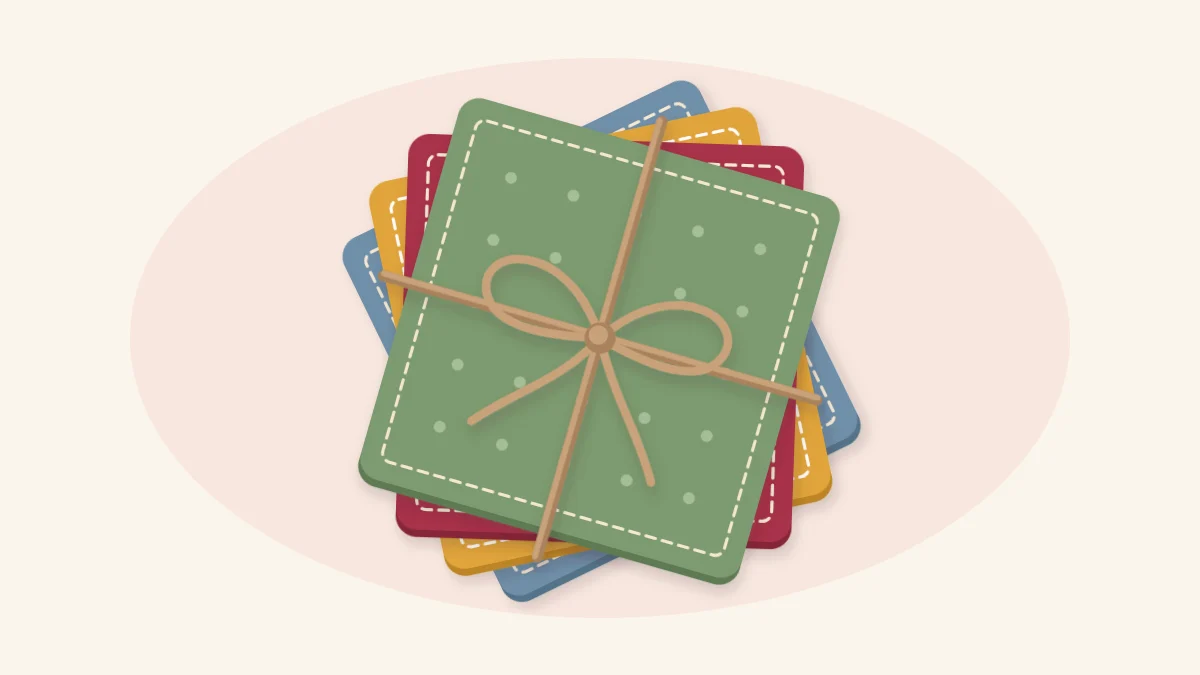
Trim every thread end, press the coasters once more and stack them with the edges aligned. Tie the stack with twine crossed underneath and knotted in a bow on top. Add a tag stating the fabric and filling, for example cotton with cotton batting, and copy the care advice from the fabric’s own label rather than writing your own.
The stitch, turn and topstitch sequence used here is the basis of other projects on this site. A pocket tissue holder is a similar size and uses up leftover squares, and an envelope pillow cover applies the same clipped corners at a larger scale.
Frequently asked questions
What size should fabric squares be for coasters?
Squares of 5 in (12.5 cm) sewn with a 1/4 in (6 mm) seam allowance give a finished coaster of about 4 1/2 in (11.5 cm). Cut two cotton squares and one batting or felt square for each coaster.
Can fabric coasters be sewn by hand?
Yes. Sew the seam with small backstitches along a drawn line, then turn the coaster and either topstitch with running stitch or close the gap with ladder stitch. Felt is easier to hand sew through than thick batting.
Why do the corners need to be clipped?
Clipping removes the extra fabric that would otherwise bunch up inside each corner after turning. Cut diagonally close to the stitching, taking care not to cut the stitches themselves, and the corners will turn into neater points.