Handmade Gift Supplies: A Basic Kit for Paper and Fabric Projects
A starter kit for paper and fabric gifts: two pairs of scissors, measuring tools, needles and thread, three glues and a few basic materials, plus what can wait.
Tutorial at a glance
Materials
- Fabric scissors
- Paper scissors
- Clear ruler and flexible tape measure
- Pencil and tailor's chalk or water-soluble fabric marker
- Mixed hand needles
- All-purpose sewing thread and six-strand embroidery floss
- Pins or small clips, and a pincushion
- Glue stick, white craft glue and fabric glue
- Craft felt sheets
- Quilting cotton
- Cardstock
- Twine and ribbon
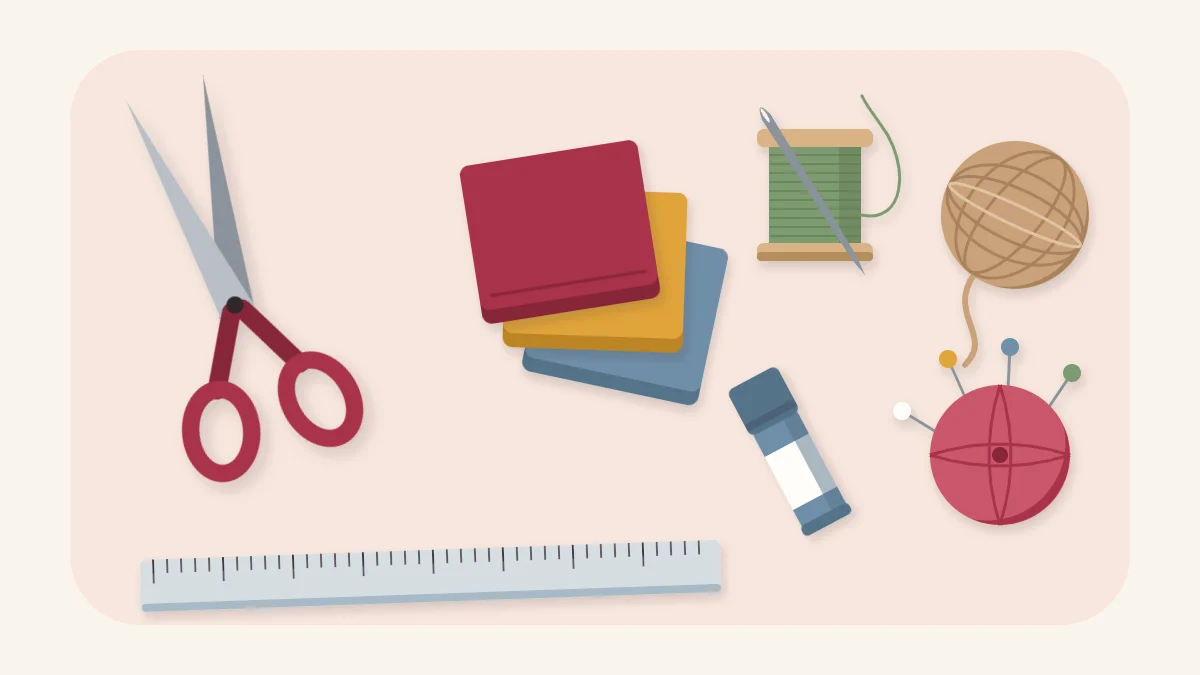
A short list of handmade gift supplies covers almost every beginner project in paper and fabric: something to cut with, something to measure with, something to join with, and a small stock of material. The kit below fits in a shoebox, and most of it may already be in a kitchen drawer or a desk.
Buy for the project in front of you rather than for every project you might make someday. The sections that follow separate what is needed from the first day, what can be substituted with a household item, and what can wait.
Cutting Tools: Two Pairs of Scissors
The single most useful rule in a craft kit is to keep fabric scissors and paper scissors apart. Paper wears down a blade edge. Scissors dulled by paper fold fabric between the blades instead of slicing it, which leaves ragged edges on felt and stretched edges on fleece.
- Fabric scissors. A pair with blades about 8 in (20 cm) long handles cotton, felt and fleece. Tie a scrap of ribbon to the handle so nobody borrows them for paper.
- Paper scissors. Any ordinary household pair works for cardstock, wrapping paper and templates.
- Small sharp scissors. Embroidery scissors or nail-size scissors trim threads and cut tight curves on small felt shapes. Useful, but they can wait.
A craft knife and a self-healing cutting mat give straighter cuts on cardstock than scissors do. They are worth adding once you make paper projects regularly. Until then, a ruled pencil line and steady scissors are enough.
Measuring and Marking
Crooked results usually begin with a guess instead of a measurement. Three inexpensive tools prevent that.
- A ruler. A clear 12 in (30 cm) ruler lets you see the material underneath. A metal edge is better if you use a craft knife.
- A flexible tape measure. Needed for anything curved, such as the distance around a can or a pot.
- A marking tool. A sharp pencil for paper and for the wrong side of light fabric; tailor’s chalk or a water-soluble fabric marker for dark fabric. Test any marker on a scrap first to confirm that the marks come out.
The Fabric Kit Versus the Paper Kit
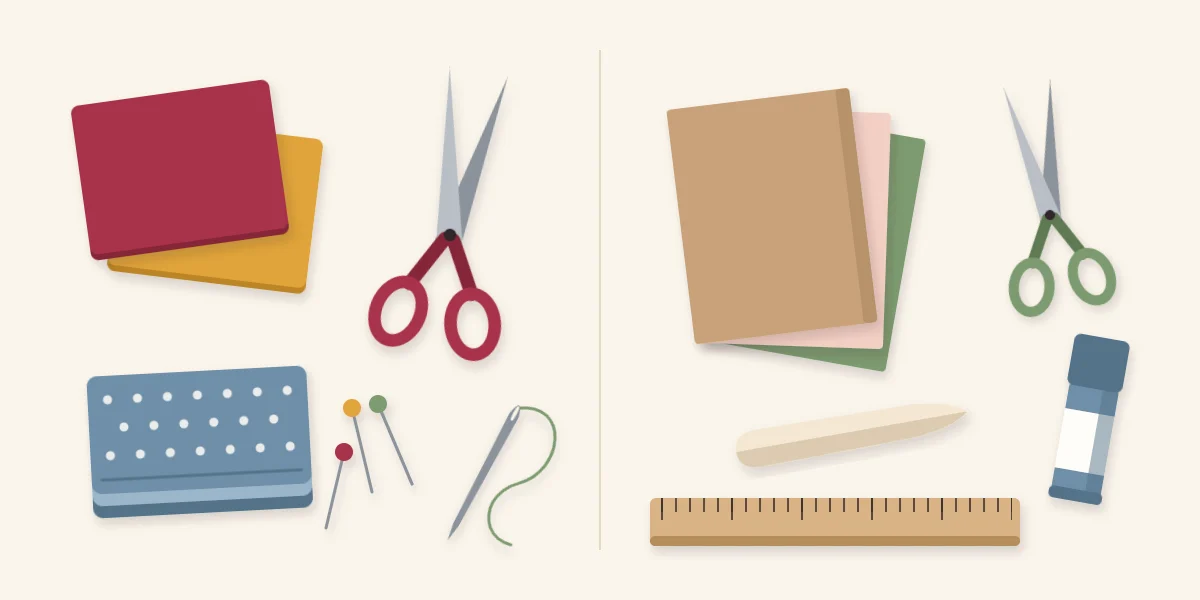
It helps to think of the supplies as two small kits that share a ruler. The fabric kit holds fabric scissors, pins, a needle and thread, folded cotton fabric and felt sheets. The paper kit holds paper scissors, a bone folder, a ruler, a glue stick and a stack of cardstock. If you plan to make only paper gifts, the fabric kit can be skipped entirely, and the reverse is also true.
Needles, Thread and Pins
Hand sewing needs very little. A mixed pack of hand needles gives you sharps for cotton and larger-eyed embroidery needles for floss. Choose the thinnest needle whose eye accepts your thread; a thick needle leaves visible holes in fine cotton.
- All-purpose sewing thread in a neutral color and one color that matches your fabric, for seams.
- Six-strand embroidery floss for decorative edges on felt. It separates into strands, and two or three strands suit most small projects.
- Pins or clips. Glass-head or plain pins hold cotton layers. Small clips hold felt and thick layers without leaving holes.
- A pincushion or a lidded tin so needles and pins are counted back in after each session.
The stitches themselves are covered in the guide to four hand-sewing stitches for handmade gifts, which is worth reading with a needle and a felt scrap in hand.
Watch out
Needles and pins are easy to lose in fabric and carpet. Count them before and after working, and store them where young children and pets cannot reach them.
Glue: Three Types Cover Most Projects
No single glue suits both paper and fabric. Three generic types are enough to begin with.
- Glue stick. For paper to paper. It adds little moisture, so thin paper wrinkles less.
- White craft glue. For cardstock, cardboard, felt decorations and trims. Apply a thin, even layer; thick blobs soak through and leave a stain.
- Fabric glue. For fabric to fabric where a seam is not practical, such as a ribbon end.
Drying and setting behavior differs from product to product, so follow the label on the one you buy and test it on a scrap of the actual material before using it on the gift.
Materials to Keep on Hand
- Craft felt. Sold in sheets, it does not fray, so cut edges need no hem. A few sheets in three or four colors go a long way.
- Quilting cotton. A medium-weight woven cotton that is easy to mark, cut and sew. Pre-wash and press it before cutting, following its care label, because cotton can shrink. Pre-cut squares are enough for small items such as a set of sewn fabric coasters.
- Cardstock. Heavier than printer paper, it holds a crease and stands up as a tag, card or cover.
- Twine and ribbon. For ties, loops, handles and wrapping.
The Kit at a Glance
| Supply | Used for | Can substitute |
|---|---|---|
| Fabric scissors | Cotton, felt, fleece | Nothing; keep one sharp pair for fabric only |
| Paper scissors | Cardstock, templates, wrapping paper | Any household scissors |
| Ruler | Measuring, guiding scores and cuts | A straight strip of stiff cardboard marked in inches |
| Cutting mat | Protecting the table under a craft knife | Thick scrap cardboard, replaced when grooved |
| Bone folder | Scoring and sharpening paper folds | The back of a butter knife or an empty ballpoint pen |
| Pins or clips | Holding layers while sewing | Small binder clips or clothespins |
| Pincushion | Storing needles and pins | A lidded tin or a folded scrap of felt |
| Tailor’s chalk | Marking dark fabric | A sliver of dry white soap |
Tip
A bone folder earns its place quickly in paper projects. Scoring a line before folding gives the crisp spine needed for a card or a hand-bound mini notebook.
What Can Wait
A sewing machine, a rotary cutter, an embroidery hoop, a hole punch, an awl, fabric paint, stuffing and specialty papers are all useful for particular projects and unnecessary for a first one. Add each when a project calls for it. If you have not yet decided what to make, the guide to choosing a first handmade gift project matches project types to the tools listed here.
Store everything in one box with the sharp tools in a closed tin. A kit that is easy to take out and put away gets used far more often than supplies spread across several drawers.
Frequently asked questions
Why do fabric scissors and paper scissors need to be separate?
Paper wears down the cutting edge of a blade. Scissors dulled this way tend to fold or chew fabric rather than cut it, leaving ragged edges on felt and fleece. Keeping one pair for fabric only keeps its edge sharp for longer.
What can be used instead of a bone folder?
The back of a butter knife or an empty ballpoint pen run along a ruler will score a fold line in cardstock. A bone folder is smoother and less likely to mark the paper, so it is worth adding if you make paper projects often.
Which glue works for felt and fabric?
White craft glue holds felt decorations and trims, and fabric glue is made for joining fabric to fabric. Products vary, so follow the label and test on a scrap of the same material before using it on the gift.